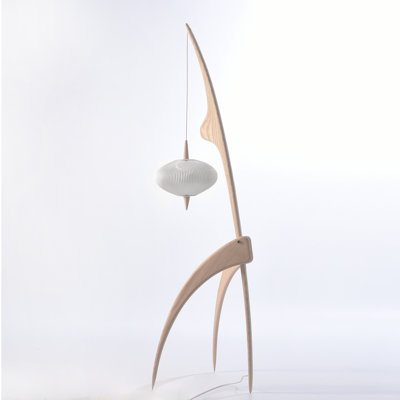
Designed by the Rispal in-house team in 1950, this lamp was surnamed the Praying Mantis lamp because of its insect-like appearance. It was revealed to the public at the 36th Interior Designers Fair in Paris in 1952 and stands as a timeless emblem of French design’s golden era. The Praying Mantis is handcrafted in France from noble materials such as oak, ash, walnut, and mahogany. Its lampshade, made out of pleated cellulose acetate, echoes the original material used during its first introduction. Cellulose acetate, derived from cotton fiber or wood pulp, qualifies as a "bio-plastic," as it is renewable, biodegradable, and manufactured without the use of oil. The unique technique employed in shaping the lampshade was an innovation pioneered by Rispal in the 1950s.