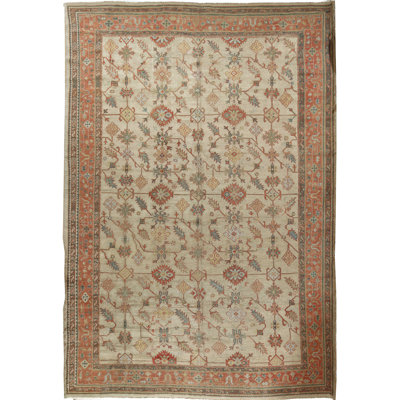
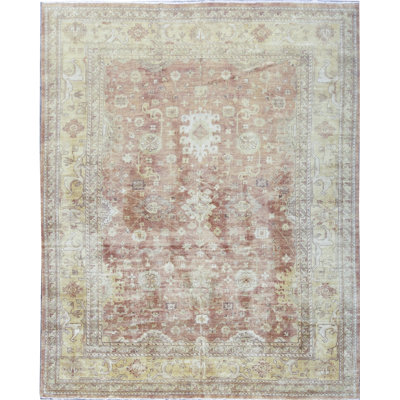
Oushak in western Turkey has the longest continuous rug weaving history, stretching back at least to the mid-fifteenth century. It has always been oriented commercially, supplying rugs and carpets, from scatters up to enormous mansion sizes, to both the Turkish/Ottoman domestic markets and to exports into Venice, Britain, and America. The best-known family portrait of George Washington has an Oushak beneath the Founder and his family. Doesn’t get more esteemed than that. Of course, the carpets have constantly changed as tastes, trends, styles, and markets evolved. In the late 19th/early 20th centuries, Persian or Persianate patterns were adopted and dimensions mutated into Western room sizes. Here the creamy sand ground supports a basically balanced allover four-panel repeat of rust to red ashiks (sawtooth edged hexagons or lozenges), horizontal bars, broken vinery sections, barbed slanted leaves, small, bracketed diamonds, and other semi-geometric small devices, all accented in green, sapphire blue, red and straw. There is no dark or another strong blue. The burnt salmon border features large outline tulips, diamonds, linear stems, and other vegetal motives. If one looks closely, a subtle large square grid pattern emerges in the field. The weave is moderately coarse, the foundation is wool, the pile is fairly long. Allover pattern Oushaks in light tones are especially prized by designers and often command a premium to medallion pieces in more saturated tones. The flexibility regarding furnishings makes them particularly desirable.