The Paris Apartment was founded in 1993 to share love of Paris and feminine decor. Vision for The Paris Apartment was to go beyond traditional pieces and curate of rare and unique heirlooms.
Rated 0 out of 5 stars.
Category
Price Per Item
Shop By Color
The Paris Apartment
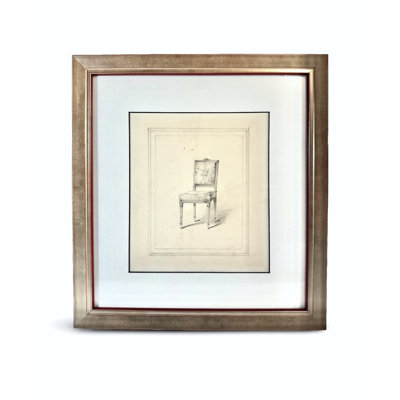
A graceful 19th-century design sketch from a Parisian atelier, this original rendering captures the understated glamour and allure of a Louis XV side chair. At the top of its squared, floral upholstered back is a delicate carved floral crest, a quiet flourish that hints at femininity without fuss. The straight fluted legs and tailored seat balance ornament with architectural restraint, so indicative of the French design that still marks it as the epitome of style today.This is the sort of chair one imagines beside a dressing table in a countryside chateau, or tucked just so in a Parisian boudoir. The woman who came to adore it, nonchalantly using it daily while arranging her hair before a clandestine outing, or perhaps while composing a note, quill in hand while perfumed roses lingered in the air.The drawing is precise but romantic, a working reference piece intended for the fabrication of fine French furniture in the decorative arts tradition. Newly framed in brushed gold with a mat and a subtle red liner, the presentation itself feels like a stage, ready for this quiet beauty to take her place in a new boudoir. Similar renderings are found in the archives of the Metropolitan Museum of Art in New York city, preserved in time as reference and resources of a bygone era.One of a kind. From a private collection curated by The Paris Apartment."
"An exquisitely hand-painted miniature portrait, La Reposée is a luminous 19th-century work capturing the timeless allure of the reclining nude. Painted in oils on a small wooden panel, this French artwork dates from approximately 1862–1864 and remains preserved in its original frame, complete with a painted gold mat, striking black border, and red leatherette backing. What sets this piece apart is its subtle complexity. The figure is rendered with exceptional care, her skin tones soft and luminous, her posture relaxed yet composed. Surrounding her, the gold-painted mat is embellished with stylized triangles that frame the composition like a theater curtain parting for a private performance. The wooden frame, a pale blonde tone with an ebonized inner border, adds architectural structure to the softness within. A rare and intimate object of beauty, this one-of-a-kind miniature is both artwork and artifact, a testament to 19th-century craftsmanship and the eternal power of the feminine form. Perfect for collectors of fine portraiture, French decorative arts, or anyone who believes beauty belongs in every room."
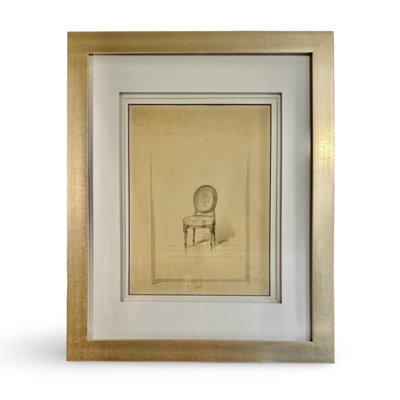
An original 19th-century drawing from a Parisian design atelier, this exquisite sketch captures the lightness and grace of the Louis XVI style at its most poetic. Stamped at the top by manufacturer Schmit & Cie, Ameublement Tapisserie Decoration, Paris, 22 rue de Charonne and numbered 316, the chair features an oval back and delicately fluted legs, drawn with the precise hand of a master draftsman. At its center, a whimsical basket of flowers, so softly rendered it appears like a fleeting dream.This drawing is more than decorative, it is a surviving piece of the design process that defined a golden age of French decorative arts. Similar drawings can be found in the archives of major institutions, including the Metropolitan Museum of Art in New York, where they are valued not only for their beauty but for their contribution to the documentation of craft, taste, and interior life in the 18th and 19th centuries.Newly framed in a brushed gold surround with a double mat and protective glass, this one-of-a-kind work remains as relevant today as when it was first created, a romantic artifact that brings history home. From a private collection curated by The Paris Apartment."
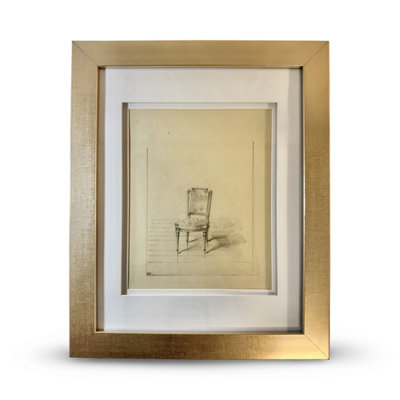
This original French architectural drawing, marked No. 1207, captures the poised elegance of a small Louis XVI salon chair with lots of personality. Sketched in graphite on softly aged paper, the rendering reveals the refined geometry and delicate ornamentation that defined the neoclassical aesthetic with its fluted legs, floral motifs, and a slender shield back with just a hint of cut curves at the corners.Created in a Parisian design atelier, this piece served as a reference for fine furniture carvers and upholsterers working in the French decorative arts tradition. Drawings of this type are rarely found outside of institutional collections and are similar in style and composition to those preserved in the archives of the Metropolitan Museum of Art in New York.Newly framed in a brushed gold surround with a double mat and archival glass, the piece evokes the quiet luxury of the 19th-century boudoir — where candlelight, silk upholstery, and whispered conversation once reigned. One of a kind, and part of a private collection curated by The Paris Apartment."
She’s tender but regal. Playful but formal. She's exactly the kind of piece you'd imagine tucked beside the queen's vanity in the Petit Trianon, where ribbons and letters mingled with lavender-scented air. Numbered 908, this rare original sketch from a 19th-century Parisian design atelier features a Louis XVI-style side chair with a gently arched shield back, slender turned legs, and the most charming detail of all, a flower basket delicately drawn at its center. Whisper-soft but unmistakable, it appears as though stitched in the threads or embroidered into fabric, echoing the sentimental motifs so loved in the era of Marie Antoinette. This drawing would have served as a reference for high-style furniture destined for private chambers, dressing salons, or the intimate corners of a grand residence. Pieces like this were not merely functional; they were expressions of femininity, craftsmanship, and ritual.Framed in brushed gold with a double mat and archival glass, this one-of-a-kind drawing has the lyrical quality of a love letter, a celebration of beauty in its most graceful form. Similar works are preserved in the decorative arts archives of major institutions such as the Metropolitan Museum of Art archives in New York, and this piece stands confidently in that lineage.From a private collection curated by The Paris Apartment."
A rare and beautifully rendered original drawing from a 19th-century Parisian design atelier, this architectural drawing captures the timeless elegance of a Louis XVI fauteuil set in front of a panelled wall. Sketched in pencil on softly aged paper, the composition reveals the artistry of the French decorative tradition, with its fluted legs, carved floral rosettes, and a graceful back.Created circa 1850 as part of a master craftsman's portfolio, the drawing served as both reference and refinement, a working study that reflects the measured sophistication and poetic geometry of neoclassical design. The added upholstery fabric flourishes give it just the right touch of whimsy.Now newly reframed in a brushed gold surround with a double mat and museum-grade glass, the piece is both historical document and objet d’art. A wonderful addition to a bousoir, salon wall, or well curated interior. One of a kind. From a private collection curated by The Paris Apartment. From Paris, circa 1850."
This antique sketch has masculine energy, dignified yet dashing, like a well-tailored gentleman in a red velvet smoking jacket. The cane back and seat are markers of its classic restraint. Marked No. 8835 in the lower corner, this original French atelier drawing depicts a Louis XVI-style armchair with a cane back and seat, a design prized for its balance of lightness and formality. Rendered in graphite with subtle color accents, the composition draws the eye to its most curious detail: padded armrests highlighted in a soft red hue, suggesting a dash of red fabric or leather that adds both comfort and quiet luxury as well as a hint of mischief and rakish charm.Created circa 1850 in a Parisian design studio, this drawing served as a model for master furniture makers. Its elegant lines, fluted legs, and restrained symmetry embody the neoclassical ideals of the period, while the warm tonal washes and handwritten number reveal the hand of the artist.Newly framed in a brushed gold surround with a double mat and protective glass, this one-of-a-kind drawing carries both visual charm and historical resonance. Ideal for a study, gentleman’s dressing room, or a curated gallery wall. From a private collection curated by The Paris Apartment."
An extraordinary and intimate 19th-century French miniature, “Le Bain” captures a rare and evocative scene: a young woman in the act of entering a steaming glass bathtub, complete with twin faucets and a delicate trail of vapor, a vision that quietly dismantles the myth that the French of the era did not bathe. Painted entirely by hand with astonishing precision, this tiny portrait reveals layers of nuance and narrative: the glass-footed tub, the distinct steam, the Napoleonic chair draped in crimson velvet, and the woman’s blonde coiffure topped with a ribboned headband indicative of early 1800s fashion. Her backward glance, direct and unashamed, adds a modern, almost cinematic touch that feels startlingly alive. Set in its original convex glass and mounted in a circular gilt-edged frame on ebonized wood, this work is preserved in remarkable condition with luminous color and breathtaking detail. It is not only a miniature painting but a window into the private rituals of a bygone time, tender, bold, and richly human. A one-of-a-kind treasure for collectors of portraiture, French decorative arts, or anyone captivated by the romance of everyday beauty and l'art de le boudoir et bain.
A rare double rendering stammped with the maker's mark from a 19th-century Parisian design atelier and manufacturer Schmit & Cie, Ameublement Tapisserie Decoration, Paris, 22 rue de Charonne, this original drawing captures the classical refinement of a Louis XVI armchair and matching side chair, two silhouettes that continue to define the standard of elegance in interiors across centuries. The sketch presents both pieces with measured precision: fluted legs, upholstered seats, and gently tapered backs, each outlined with quiet confidence and grace.At the time this drawing was made, such designs were considered both fashionable and forward-thinking, a nod to antiquity with an eye toward modern comfort. That balance of history and innovation is exactly why these styles endure today, still considered among the most perfect expressions of proportion, symmetry, and decorative restraint.Framed in brushed gold with a double mat, this one-of-a-kind sketch is not just a study, it’s a love letter to timeless design. A rare pairing from a private collection curated by The Paris Apartment."
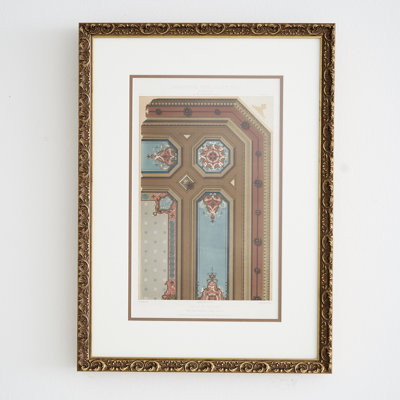
"A striking and richly detailed architectural lithograph for a gilded game room, this antique French print captures the ceiling design for a salle de billard (billiards room) in a Louis XVI-style Parisian hôtel particulier. Executed with vibrant pigments — including true accents of gold, brick red, and turquoise — the composition reveals the grandeur and precision of 19th-century decorative design. The piece is marked with extensive architectural details and provenance, including the series title “L’Architecture Privée au XIXᵉ Siècle (Troisième Série)” by César Daly, architect. The lower inscription reads: “Salle de Billard, Hôtel, Boulevard Exelmans, à Paris – Plafond, par MM. Edm. Guillaume, Archte. & Ouri, Peintre Décorateur.” Lithographed by Charpentier and printed by Lemercier & Cie, Paris. A rare and visually arresting example of historic French interior design, this lithograph is part of a legacy of private architectural commissions and remains a reference point for connoisseurs and collectors. Ready to be framed and displayed as an objet d’art, it offers both historic resonance and vibrant visual impact. Newly and professionally framed in an ornate gilt frame with delicate Rococo-inspired scrollwork, the lithograph is set within a recessed archival matte with a fine gold inner border. This presentation not only enhances the vibrancy of the piece but elevates it to gallery-worthy status. In excellent condition and ready to hang, it makes an extraordinary statement in a study, gallery wall, or richly layered interior."