
AphroChic
Founded in 2007, AphroChic is a modern lifestyle and design brand celebrating African Diaspora culture through thoughtfully crafted home décor, storytelling, and contemporary design.

AphroChic is your source for luxury home decor from across the African Diaspora, with pieces handcrafted by artists and artisans in Morocco, Egypt, Kenya, South Africa, and across the globe.
AphroChic
14 Items

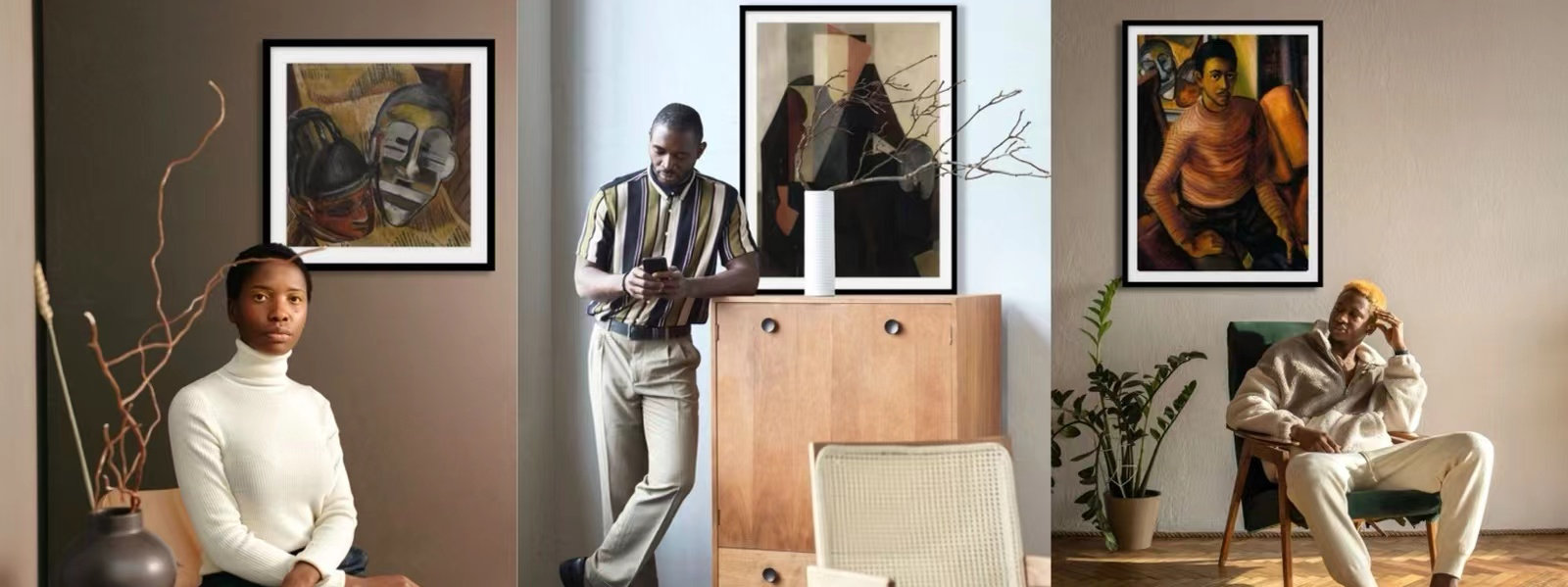
This 1934 Self-Portrait by Harlem Renaissance artist Malvin Gray Johnson was completed shortly before the artist's tragic passing that same year at the age of 38. Johnson’s original oil painting depicts the artist in casual dress and pose, in front of a representation of another of his works — 1932's Negro Masks. Although known for his portraits, several of Johnson's most celebrated efforts, including 1929's Swing Low Sweet Chariot and 1930's Roll Jordan Roll, are Cubist works. Though his paintings were exhibited by the Society of Independent Artists at the Waldorf-Astoria Hotel and acquired by the Whitney Museum among others, many were lost or neglected after his death so that now only 60 remain scattered across various collections. His passing was met with mourning from the whole Harlem Renaissance community, which until then, had regarded the much-awarded artist as among its brightest lights. This print of one of his most iconic works is reproduced by archivists in the United Kingdom using museum quality paper and ink, resulting in a colorful piece of art that is faithful to the original.

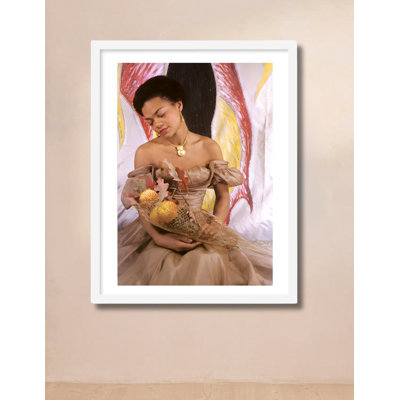
Girl in Pink Dress, 1927, by acclaimed African American artist, Laura Wheeler Waring depicts a young woman in the Jazz Age style of the Harlem Renaissance. Known primarily for her landscapes and still lifes, the artist, who was born in Connecticut and studied extensively in Paris before settling in Philadelphia to teach at Cheyney University, completed striking portraits of fellow contemporaries in the New Negro Movement. This work is emblematic of Wheeler's studies of Black women of the time, defying stereotypes of race and class with depictions of Black women as sophisticated and modern — indicated here by the woman's trendy flapper-style dress and bobbed haircut. It is one of several such images that the artist produced, drawing the praise of Alain Locke, one of the New Negro Movement's intellectual founders. Wheeler also worked with another of the movement's intellectual pillars, W.E.B. Du Bois as an illustrator, contributing more than twenty cover and copy illustrations to his magazine, The Crisis.
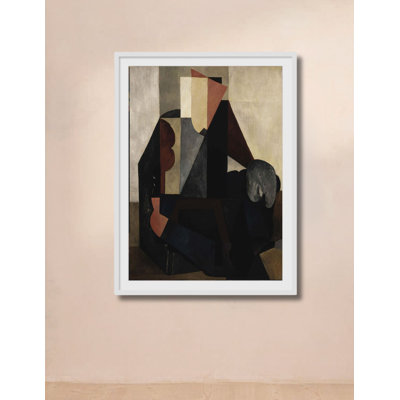
Un Pintor En Reposo, literally, "A Painter in Repose (or at rest)," is a 1916 work by the renowned Mexican artist, Diego Rivera. Known for many things, including his famously tumultuous relationships with both the Communist Party and equally legendary painter, Frida Kahlo (whom he married twice), Rivera — of African and Indigenous, as well as Portuguese Jewish and Spanish ancestry — is perhaps best remembered artistically for his politically-charged murals. Yet, throughout his career, Rivera displayed a remarkably versatile talent that was equally comfortable in the genres of Realism, Pointillism, Post-Impressionism and Cubism, as well as his unparalleled Muralism. Un Pintor En Reposo comes from a very early moment in the artist's journey during which he lived and studied across Europe. The work is one of many that he produced between 1912 and 1917, a period in which he embraced Cubism, inspired by meetings with both Pablo Picasso and Paul Cézanne, the latter himself remembered as the great bridge between his own Post-Impressionist movement and that of the Cubists. Exploring Cézanne's theory that any physical object can be represented in art through reference to the cylinder, sphere or cube — whether singly or in combination — the painting represents the simple subject of a seated painter as a complex and evocative mix of shapes, colors and impressions. Printed on 5.57 oz smooth matte fine art paper, this work is available framed and unframed, reproduced by archivists in the United Kingdom using museum quality paper and ink, resulting in a piece that is faithful to the original.
AphroChic
People Print
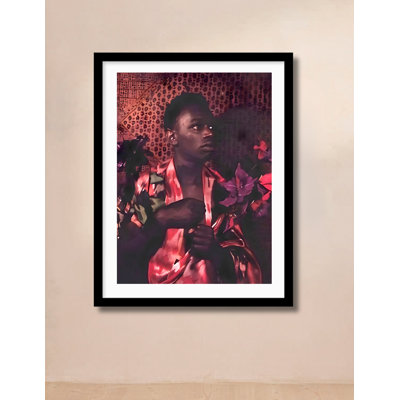
Almost nothing is known of the enigmatic young dancer, Allen Juante Jergerhadutha Meadows, featured in this image, except that his visage was inspirational to some of the leading creatives of the Harlem Renaissance period, both in and outside of the Harlem Black community. Meadows is reputed to have been born in British Guiana, though when and under what circumstances he immigrated to New York are unclear or unknown. He is remembered as a dancer, yet almost no records of his performances remain. Yet the mystery only serves to increase the allure of his undeniably striking visage, which inspired, among others, the Harlem Renaissance sculptor Richard Barthe who immortalized him in the 1939 sculpture Boy with a Flute. Barthe later introduced Meadows to controversial photographer and author Carl Van Vechten. Similarly taken with Meadow's aesthetic, Van Vecthen created a series of photographs featuring him, which remain today as the most lasting memory of this otherwise forgotten figure of the New Negro Movement. This archival museum quality print, presented on 100% acid free, 5.57 oz, smooth matte fine art paper, is sustainably printed to order in the UK, perfect for making a beautiful statement in any room of your home.
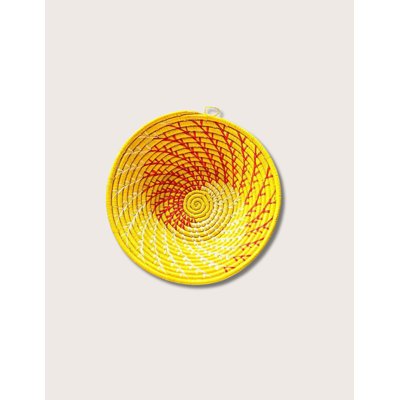
Looking for one-of-a-kind pieces for entertaining? This Large Gold Handwoven Ugandan Decorative Basket is exactly what you need. Handmade by artisans in Uganda, each bowl is a work of art for your walls. Available in large and medium sizes, these sustainably made bowls, are handmade with raffia and banana stalks, and will last for years to come.
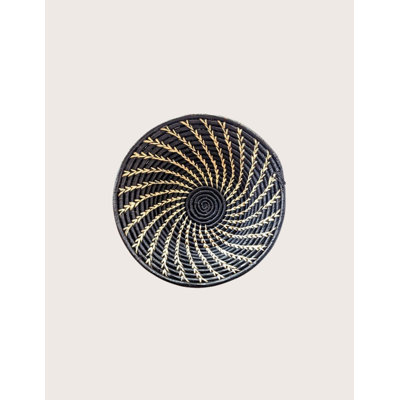
Looking for one-of-a-kind pieces for entertaining? This Large Black Handwoven Ugandan Decorative Basket is exactly what you need. Handmade by artisans in Uganda, each bowl is a work of art for your walls. Available in large and medium sizes, these sustainably made bowls, are handmade with raffia and banana stalks, and will last for years to come.
AphroChic
People Print
This archival museum quality print of a Carl Van Vechten photo of singer, actor and activist, Eartha Kitt is presented on 100% acid free, 5.57 oz, smooth matte fine art paper. Born into difficult circumstances as Eartha Mae Keith in 1927, Kitt became one of the most recognizable faces and unforgettable voices of the 20th century. By 1945 she was a dancer with the famed Katherine Dunham Company, and her remarkable beauty and singular voice quickly led to a series of successes both in the theater and on the radio. She starred as Helen of Troy in Orson Welles' 1950 production of Faustus. In 1967, she defined Catwoman in the Batman television series. And in 1992, her sultry Lady Eloise became an iconic character in Eddie Murphy’s Boomerang. An outspoken advocate of feminism and civil rights, Kitt’s career suffered in 1968 when she made openly negative remarks about the Vietnam War at a luncheon with First Lady, Lady Bird Johnson. In 1975, The New York Times reported that the CIA had compiled a dossier on Kitt at the behest of President Lyndon B. Johnson. Despite this, throughout her illustrious career Kitt recorded 17 studio albums, 8 live albums, more than 50 singles, wrote 3 autobiographies, and starred in countless films and television series. A true heroine, this reproduction print, produced in color and sustainably printed to order in the UK, is the perfect statement piece for any interior.
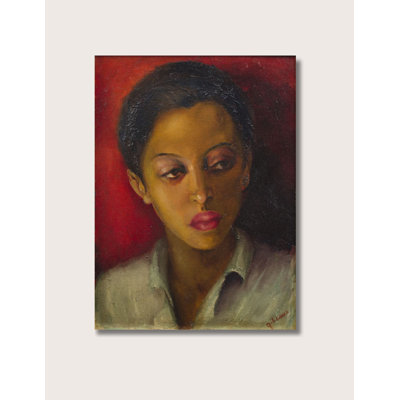
Time in Paris, 1932, a close study of the face and features of a Black woman, was created by acclaimed African American artist and Harlem Renaissance figure, Laura Wheeler Waring. Known primarily for her landscape and still life paintings, the artist, who was born in Connecticut and studied extensively in Paris before settling in Philadelphia to teach at Cheyney University, completed striking portraits of fellow contemporaries in the New Negro Movement. Among her most noted capture the images of James Weldon Johnson, Mahalia Jackson and W.E.B. Du Bois among several others. She also worked with Du Bois as an illustrator, contributing more than twenty cover and copy illustrations to his magazine, The Crisis. Contrasting her realist portraits, 10 of which reside in the collections of the Smithsonian, Wheeler was known for her impressionist creations, which frequently explored the beauty of flowers and nature.

Looking for one-of-a-kind pieces for entertaining? This Medium Gold Handwoven Ugandan Decorative Basket is exactly what you need. Handmade by artisans in Uganda, each bowl is a work of art for your walls. Available in large and medium sizes, these sustainably made bowls, are handmade with raffia and banana stalks, and will last for years to come.
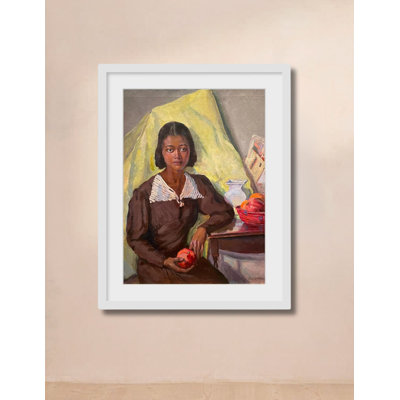
Girl with Pomegranates, 1938, by acclaimed African American artist, Laura Wheeler Waring is a mix of genres, combining several of the artist's most noted strengths. Blending elements of portrait, still life and landscape, the image depicts a young woman sitting with a bowl of pomegranates, one held in her hand, before a setting in which a landscape painting is partially obscured by the backdrop. Known primarily for her landscapes and still lifes, the artist, who was born in Connecticut and studied extensively in Paris before settling in Philadelphia to teach at Cheyney University, completed striking portraits of fellow contemporaries in the New Negro Movement. This work is emblematic of Wheeler's studies of Black women of the time, defying stereotypes of race and class with depictions of Black women as sophisticated and modern. Here, it is the inclusion of the pomegranate that is most telling. In the myths of ancient Egypt and other Mediterranean cultures, the fruit is a symbol of fertility and sensuality as well as prosperity. It was frequently depicted in hieroglyphs on Egyptian tombs and whole pomegranates have been found among the funerary goods of Amenhotep II, Thutmose IV, and various nobles interred at the necropolis of Thebes. Later, in Christian art, the pomegranate would be widely employed as a symbol of wealth, royalty, divinity and eternal life in paintings such as Botticelli's Madonna of the Pomegranate (1487) and the similarly-themed, The Virgin with the Pomegranate (1426) by Giovanni da Fiesole, a Dominican friar and painter, also known as Fra Angelico. Wheeler’s work brings all of this symbolic power to bear, placing it literally in the hands of a Black woman as she looks serenely out at the viewer.

Looking for one-of-a-kind pieces for entertaining? This Large Blue Handwoven Ugandan Decorative Basket is exactly what you need. Handmade by artisans in Uganda, each bowl is a work of art for your walls. Available in large and medium sizes, these sustainably made bowls, are handmade with raffia and banana stalks, and will last for years to come.
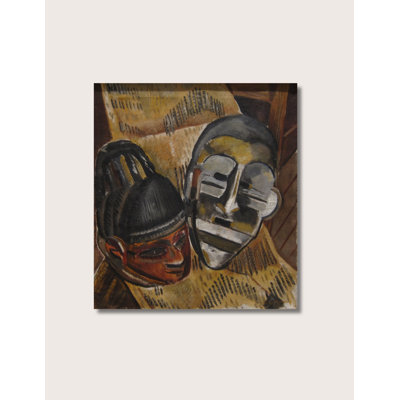
This 1932 work by Harlem Renaissance artist Malvin Gray Johnson depicts two West African masks — one Yoruba, the other Bwa. The work is a response to several occurrences in the art scene at that time. First, was a challenge issued by Johnson's friend and mentor, Alain Locke, author of the 1925 New Negro Anthology, to several Black artists to find inspiration in African art. Second, it was a rebuff to the presentation of African art, which was growing in popularity at the time along with European modernist art, as the work of "savages," despite being a significant inspiration for Modernism itself. Negro Masks is one of sixty surviving works by the artist, who tragically passed away at the age of 38 in 1934. Celebrated in his time for his portraits, Malvin is remembered as a pioneering example of Symbolic Abstractionism and Cubist painting. Printed on 5.57 oz smooth matte fine art paper, this work is available framed and unframed, reproduced by archivists in the United Kingdom using museum quality paper and ink, resulting in a piece that is faithful to the original.
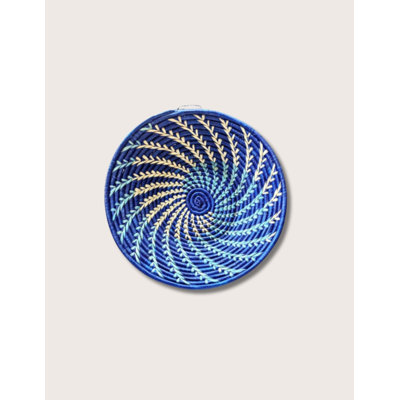
Looking for one-of-a-kind pieces for entertaining? This Medium Blue Handwoven Ugandan Decorative Basket is exactly what you need. Handmade by artisans in Uganda, each bowl is a work of art for your walls. Available in large and medium sizes, these sustainably made bowls, are handmade with raffia and banana stalks, and will last for years to come.
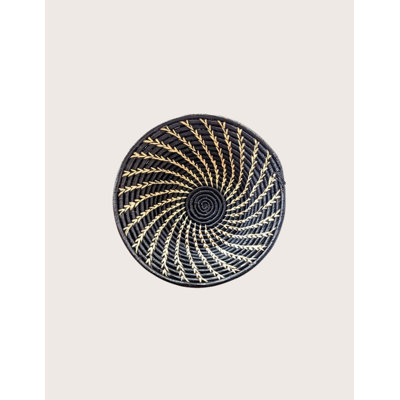
Looking for one-of-a-kind pieces for entertaining? This Medium Black Handwoven Ugandan Decorative Basket is exactly what you need. Handmade by artisans in Uganda, each bowl is a work of art for your walls. Available in large and medium sizes, these sustainably made bowls, are handmade with raffia and banana stalks, and will last for years to come.