The Signature Classic Collection
6 Items
Fast Delivery
to:
Filter By Category
Filter By Price
Filter By Color




Filter By Availability
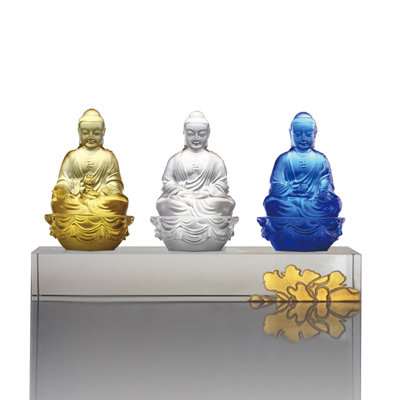
Buddha embodies compassion and wisdom, and the Buddha sculpture is a reminder for all of us to love and care. “Present Mindfulness” is a set of three Buddhas: Amitabha Buddha, Shakyamuni Buddha, and Medicine Buddha, representing the past, the present, and the future of cultivating peace. They remind us that the past is understood through learning, and the present is understood through cultivation. This gives us a grasp of the future and releases us from apprehension. In Buddism, praying to Amitabha Buddha is for cultivating the mind of clarity; praying to Shakyamuni Buddha is for enlightenment, peace, and happiness; praying to Medicine Buddha is for healing and good health.
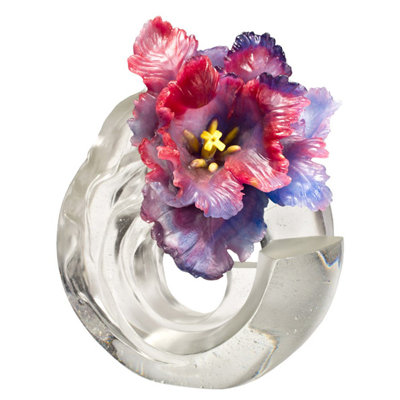
The “Flaming Parrot” is a particularly vibrant subspecies of the tulip family. Drawing upon this curious flower as inspiration, this crystal art piece combines two separate parts (flower and stalk) to create a seamless circular flow. They are made separately and fired at different temperatures, before finally being joined together in one kiln. The artwork captures the perfect moment of a flower billowing in a gentle spring breeze, as if in a mesmerizing dance of passion. Each flower petal, crafted from powdered glass, boasts several hues of brilliant fiery color. Having undergone repeated modification in the studio, “Sunny Day” reveals masterful craftsmanship, and artistically expresses a heart free of restraint and full of fire. A crystal glass flower sculpture of the Flaming Parrot flower represents or symbolizes celebrating passion and free-spirited creativity.
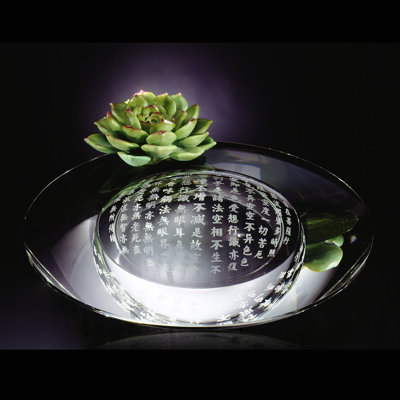
This highly limited art piece by Loretta H. Yang reveals beneath a pond-like reflection scripture from the infamous Heart Sutra. Through the refraction of light and shadow, a pool of clarity is revealed, resulting in enlightenment. See through all to let go of distracting thoughts. The depicted plant is the houseleek, a perennial succulent and what Buddhists call a “thousand leaved lotus”. With every fallen leaf, a rosette forms. This means “to change past wisdoms”, the metaphorical transformation of one’s weaknesses into lotuses.

This piece belongs to Loretta H. Yang’s signature series “Formless, But Not Without Form,” which is based on the Diamond Sutra and her personal insights into life. The natural color vein patterns and bubbles formed in the glass during the production process are used to convey the Buddhist concept of impermanence. Understanding the evanescent nature of all phenomena makes life seem like a tiny bubble in a translucent universe, ushering in the unbounded freedom that comes with the transcendence of both being and nonbeing. In view of the impermanence of life, every moment is precious. With the wisdom of “signlessness” we come to see that attachment to any aspect of conditioned phenomena is the root cause of all suffering; overcoming this discrimination engenders insight into the nonduality of self and other, underscoring our connection with all living beings. Yang has developed a glasswork technique which gives full expression to the richness of Eastern philosophy. Inspired by the cardinal virtues of wisdom and compassion, and utilizing an artistic language which combines substance and emptiness, her work reflects the passage in the Diamond Sutra which reads, “All conditioned things are like a dream, an illusion, a bubble, a shadow.” This piece was produced using a combination of lost-wax casting (pâte de verre) and hot-pour casting. First, a Buddha image formed through pâte de verre is heated and placed within a sand mold. Next, molten glass is poured into the same mold, sealed, and left to set. The result is a chimerical image enclosed in transparent glass, producing a poetic effect suggestive of the ephemeral nature of the world. In 2017 this piece was acquired by the Museum of Decorative Arts (Musée des Arts Décoratifs) in Paris, becoming the first acquisition of Chinese glass art in its century-old collection. More than merely the masterful execution of the lost-wax casting technique, each piece produced by Yang is a manifestation of her sense of mission, philosophy of life, and insight into the teachings of Buddhism.
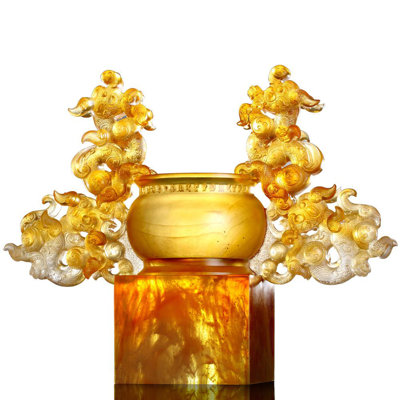
The two dragons represent a reverence for heaven and earth. The four dragons rely on each other to represent protection. The base of the ding is simplified into a square and created through kiln-fired powder glass. It is polished, imbued with Liuli streams and bubbles to represent the inextinguishable cycle of life as if it were a lively movement in a symphony. Engraved on the inner wall of the ding are a treasure for all generations. Adorned in gold foil, it conveys a message of protection and blessing to our generations.
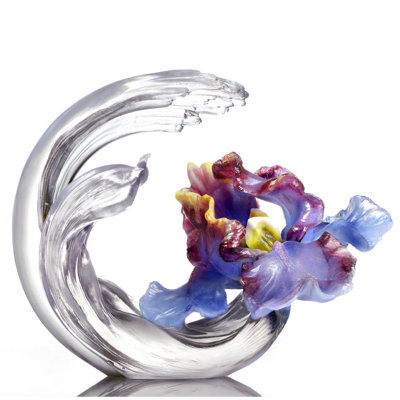
In ancient Greece, the goddess Iris acted as a messenger from the Elysian fields. Via rainbow. Hence, the dazzling rainbow-like iris flower. The flower sculpture seen here has two starkly contrasting parts—flower and leaf—both crafted and fired individually before being refired once more together. Working in tandem, the sharp features of the leaf show willful determination while the vibrant colors of the flower reveal a softer radiance. To that effect, the quality of the iris is in its contrasting, yet deeply complementary personalities. The iris is already inherent pretty. Yet it possesses remarkable determination, and for that that the iris is all the more beautiful.