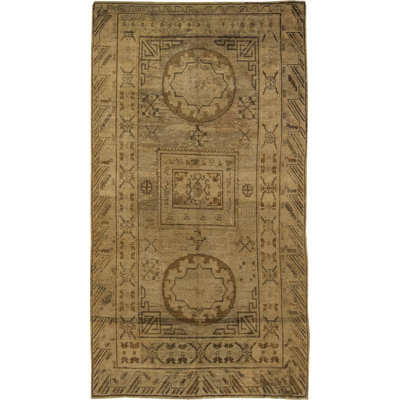
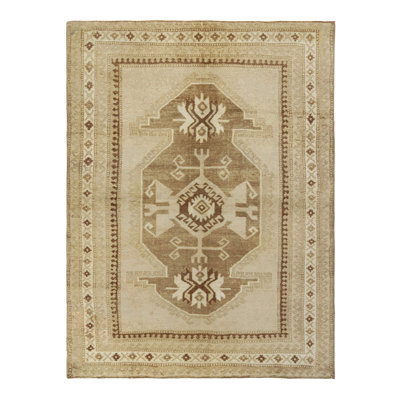
This vintage runner rug is a 4x9 Turkish distressed piece, made with hand-knotted wool circa mid-20th century. It is an exciting new addition to our collection of distressed Turkish runner rugs.On the Design: Admirers of the craft will especially appreciate vintage Turkish distressed rugs as enduring works with their own layered history and artistry. Made with hand-knotted wool, this Turkish distressed runner rug features a dense diamond grid rendered in muted tones of beige, ivory, and soft brown, creating a rhythmic and almost mosaic-like texture. Its balanced repetition makes it a versatile piece, ideal for grounding a hallway or entryway with both structure and understated elegance. As much a statement of modern minimalism as it is a reflection of timeless Anatolian artistry, this rug bridges folk tradition with contemporary appeal.Condition: This vintage Turkish Distressed Rug further enjoys good condition for its age and origin.

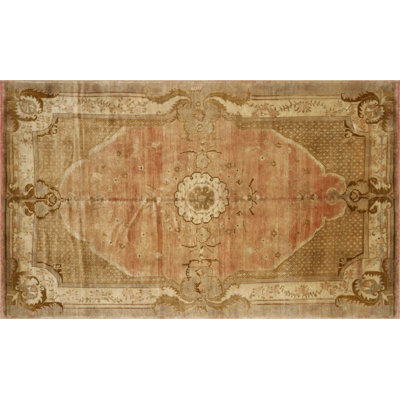
Hand-knotted in wool, this 5x9 rug originating from Turkey, circa 1950-1960, is a very special piece featuring a refreshing mid-century classical design and is the latest to join Rug & Kilim’s coveted Vintage collection. On the Design: Connoisseurs will cherish this personal vintage rug meant to catch the eye, yet still so atypical in its color and design choices that are so complementary to each other making it a comfortable, and inviting piece. Keen eyes will admire this dense and traditional design with rich, time-honored colors like brown, orange, gray, ivory, and black—that all come together in an unexpected symphony to create the most regal look. This vintage Turkish rug is embellished with a geometric medallion, floral detailing, and a border with meticulous traditional patterns. Altogether, this approach represents a refreshing and fabulous play of traditional Oriental rug design and a modern air. Collectors and designers will love this gracious rug with a cultured personality, well suited for a wide array of decor possibilities.Condition: This vintage Turkish rug prevails in great condition for its age and origin.

Doris Leslie Blau
Vintage One-of-a-Kind Rectangle 10' x 13'8" Area Rug
A modern second quarter 20th-century Chinese oriental rug, the cinnamon field with an overall pattern of floral roundels and leafy vinery with delicate scrolling interlace beneath an overblown contrasting polychromatic bouquet of sensuous blossoms and delicate vinery near the lower right corner. These tend to be more open and spacious than the antique oriental rugs from Western Asia. Maintained mostly in blues, golds, ivories, and beiges, with classical symbols of longevity, elaborate lotus blossoms, chrysanthemums, cloud-band motifs, foo-dogs, and birds, antique Chinese vintage rugs are frequently visible in paintings from as early as the T'ang Period. In contrast to earlier Chinese antique rugs, the twentieth-century Chinese Art Deco rugs can be quite spare in design and quite radical in color, catering to the western taste shaped by the birth of the modernist movement. They are often comprised of geometric or abstract patterns. The most recognizable rugs from the 1920s and 1930 were made by Walter Nichols – the American who manufactured deco carpets in Tientsin.

Handwoven in wool, this 11x13 vintage kilim is the latest addition to Rug & Kilim’s coveted Kilim & Flatweave collection. On the Design: This kilim is a mid-century interpretation of one of the oldest of the panel woven styles of its same name. The eye is naturally drawn to such a rich play of browns, beiges, grays, golds and creams in stripes with pleasing repetition and presence alike. The bisected design further connotes the aforementioned panel-weaving design that weaves two narrow columns into one gorgeous new work. This is a collectible design that further enjoys meticulous detail and smart polychromatic colorway with a natural sense of movement.Condition: This vintage kilim further enjoys good condition for its age and origin.
Rug & Kilim
One-of-a-Kind 5'0" x 6'0" Area Rug
Free 3-Day Delivery
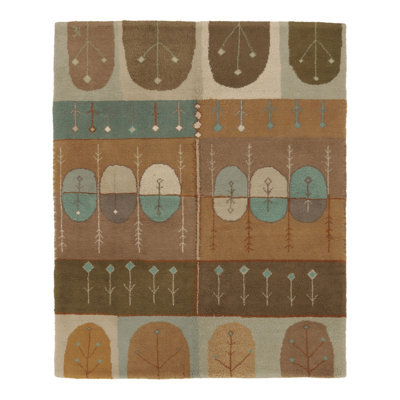
Handwoven in wool and cotton, circa 1970, this 5x6 Scandinavian flatweave rug is an exclusive Alberto Levi piece and a charming addition to Rug & Kilim's Scandinavian collection. Originating from Hungary, the rug draws inspiration from early Nordic folk-art textiles through an imaginative geometric composition rendered in earthy brown, camel, ivory, and muted aqua tones.The design reflects the refined artistic vision associated with Alberto Levi's contemporary textile curations, where traditional Scandinavian influences are reinterpreted through a distinctly modern lens. Across the field, geometric compartments organize stylized botanical motifs, abstract seed forms, and linear tribal-inspired accents into a rhythmic patchwork composition that feels simultaneously playful and highly disciplined.Particularly compelling is the rug's balance of warmth and minimalism. Earthy browns, camel tones, soft ivory, sage, and muted aqua interact with remarkable subtlety, creating visual texture without overwhelming the composition. The compartmentalized structure introduces architectural clarity while preserving the handcrafted spontaneity characteristic of folk-art weaving traditions. The result is a sophisticated Scandinavian flatweave whose artistic simplicity, tactile surface, and restrained palette embody the timeless decorative sensibility associated with Alberto Levi's collectible works.
Via Como
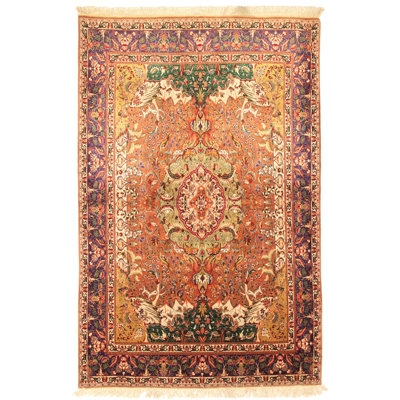
Fine Tabriz Rug 5' X 7'8"
Handcrafted luxury with timeless design, each rug is a statement piece, blending rich texture, bold artistry, and enduring quality