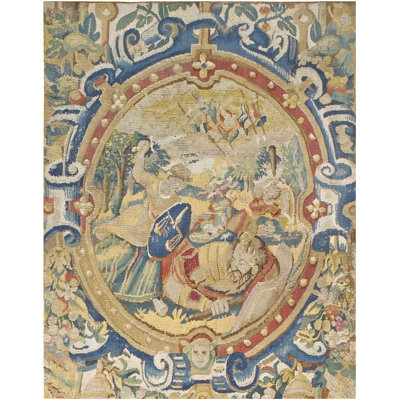
17th Century Flemish Biblical Tapestry Fragment: David and Goliath.
Origin: Southern Netherlands (likely Brussels or Antwerp). Date: Circa
1650–1680 (Late Baroque).
While it falls under the umbrella of “Flemish,” the sophistication of
the cartouche suggests it may have come from a Brussels workshop.
Brussels was the gold standard for these framed narrative pieces,
often following “cartoons” (designs) inspired by artists like Peter
Paul Rubens.
Design Style: Cartouche with architectural strapwork and a central
narrative medallion.
Materials: Hand-woven wool and silk.
The Scene: David and Goliath
The central medallion depicts the immediate aftermath of the biblical
battle between David and Goliath.
The Action: You can see the young, athletic figure of David standing
over the fallen, armored giant, Goliath. David is often shown in this
specific pose—grasping the giant’s hair or preparing to use the
giant’s own massive sword to finish the deed.
The Background: In the upper register of the medallion, you can see a
faint, secondary scene of soldiers or a mountainous landscape,
representing the valley where the Israelite and Philistine armies were
stationed.
The Symbolism: In the 1600s, this scene wasn’t just religious; it was
often used as a political allegory for a smaller nation or a righteous
cause overcoming a massive, oppressive force.
Scrollwork & Masks: The oval is surrounded by “strapwork” and blue
scrolling “crescents.” At the bottom center, there is a small,
stylized human mask or “mascaron,” which was a staple of Baroque
decorative arts.
Foliage: The corners are filled with lush fruit and floral clusters,
representing abundance. The blue and gold tones are highly
characteristic of the high-quality dyes used in major Flemish
workshops.
Capturing a moment of triumphant drama, this seventeenth-century
Flemish tapestry fragment centers on the timeless narrative of David
and Goliath. Enclosed within a masterful Baroque cartouche, the scene
depicts the young hero standing over the fallen giant, a powerful
allegory of courage and divine favor. The central medallion is framed
by exquisite blue strapwork and architectural C-scrolls, punctuated by
a delicate classical mascaron (mask) at its base and overflowing with
the lush floral abundance characteristic of the golden age of Flemish
weaving.
Woven with an artistry that transforms wool and silk into a vivid
historical window, the piece showcases the deep indigo and soft ochre
palette that defines the finest European textiles of the era. A closer
look at the upper register reveals the faint, ethereal figures of the
Philistine army, providing an atmospheric depth that contrasts
beautifully with the finely detailed armor of the foreground figures.
This fragment is more than a textile; it is a storied relic of
seventeenth-century grandeur, offering a sophisticated blend of heroic
storytelling and ornamental elegance that commands attention in any
setting.